
Preview of the new TeamsWork site · not the live website

Understanding Roles in TeamsWork Apps: Owners & Members Capabilities

Marc (TeamsWork) · Sep 19, 2024 · 2 min read · Updated: Oct 23, 2026

Understanding Roles in TeamsWork Apps: Owners & Members Capabilities

In TeamsWork apps such as CRM as a Service and Billing as a Service, certain features, such as configuring forms or managing workflows, need to be controlled and maintained by specific users. To keep operations running smoothly, roles centralize these responsibilities. This article explains the differences between Owners, Members, and Collaborators and what each role can do.

Owner: Can See and Configure Everything

Member: Can Only View Their Own Records

Collaborators: Follow Records Created by Other Members

Roles in CRM As A Service

Owner: Can See and Configure Everything

The Owner has the most control over an app's configuration and management. This role is typically assigned to the people responsible for overseeing how the app works and making sure it fits the business. Owners are often team managers or IT application support. The Owner role is also assigned automatically to the person who subscribes to the app.
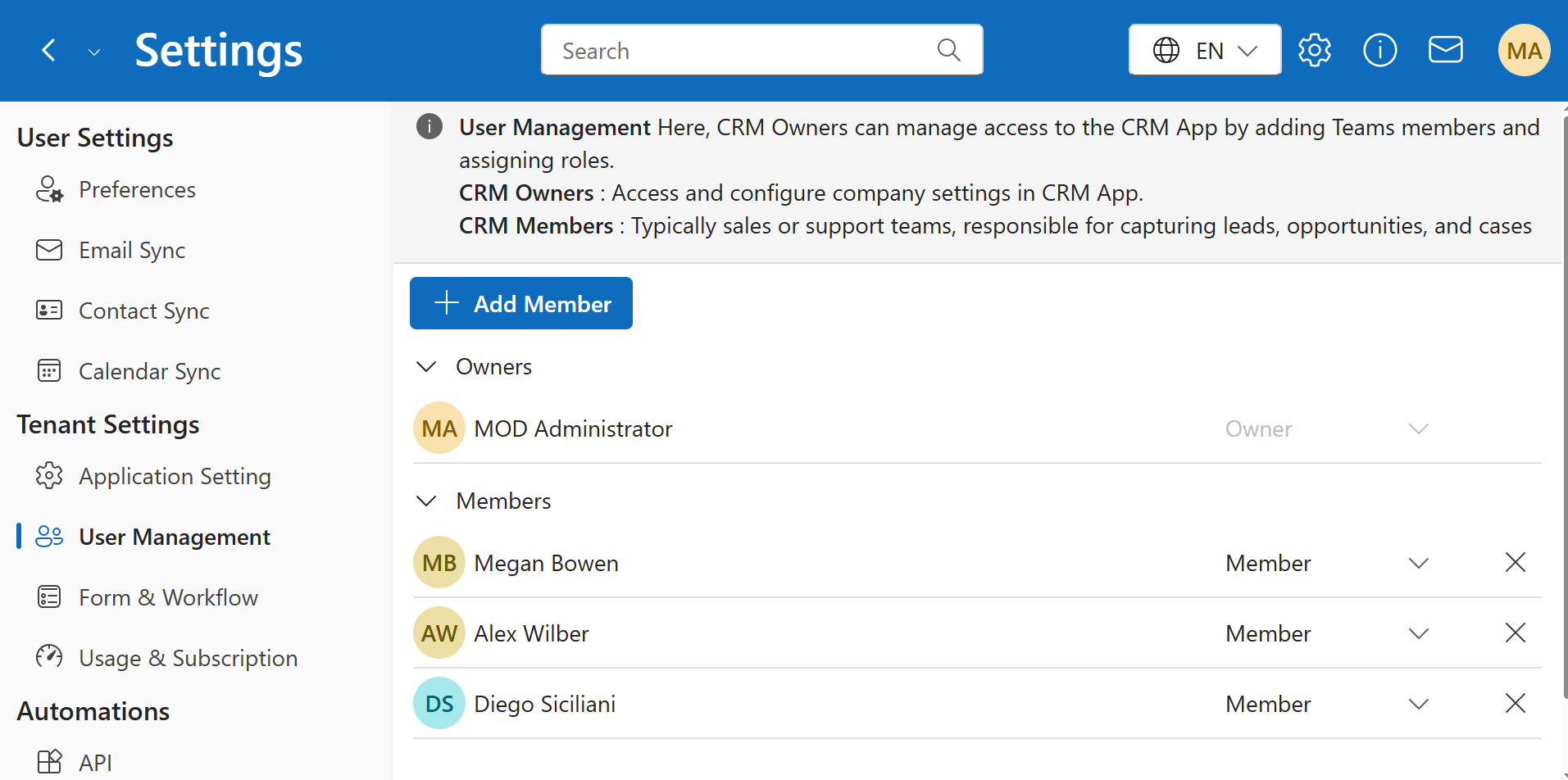
User Management settings

Owner Capabilities:

Owners can see everything, including all records that members and other owners create.

  • Managing Users: Owners can add or remove users, assign roles, and manage permissions across the app.
  • Managing Forms: Owners can customize the forms that capture the data your team works with, tailored to the needs of the business.
  • Configuring Workflows: Owners can create and adjust workflows that automate business processes, such as assigning records or setting up follow-ups.
  • Managing App Settings: Owners control the app's configuration and integrations, keeping everything consistent for the whole team.

These controls make the Owner role central to shaping how each app works for your business.

Member: Can Only View Their Own Records

While the Owner configures and manages the app, the Member has a more limited but equally important role. Members are the people who actively use the app day to day, working with the records they own.

Member Capabilities:

  • Viewing Their Own Records: a Member can view only the records they have created, such as leads and opportunities in CRM as a Service or documents in Billing as a Service.
  • Restricted Access: unlike Owners, Members cannot change the app's configuration or manage workflows and settings. This keeps the app consistent, so only those with the right authority can make critical changes.

Collaborators: Follow Records Created by Other Members

While Members can only view their own records, Collaborators let a Member access specific records created by other team members, so they stay informed without taking ownership.

Understanding the difference between Owners, Members, and Collaborators helps you balance confidentiality with collaboration. Owners handle configuration and management, Members focus on their own records, and Collaborators bridge the gap with selective visibility, so a Member can follow specific records created by others without seeing all the data. Roles set what each person can do, and each record's access level sets who can see it. For how those levels work, see visibility rules in TeamsWork apps.

Together, these roles keep your team efficient and aligned with your business goals.

Try CRM for Free Now!


Still switching tabs to get things done? TeamsWork brings your business apps into Microsoft Teams — Ticketing, CRM, Checklist, and Billing — so support, sales, and tasks all live where your team already works. Microsoft Solutions Partner certified, trusted by 500+ organizations.
Customer Review: Fresno Chaffee Zoo on Ticketing as a Service

Customer Review: Fresno Chaffee Zoo on Ticketing as a Service

Fresno Chaffee Zoo shares how Ticketing as a Service streamlined safety and security operations, cutting response times and improving cross-shift coordination.

Marc (TeamsWork) · Aug 19 · 3 min read

What Is Lead-to-Cash and How Does It Work?

What Is Lead-to-Cash and How Does It Work?

What is lead-to-cash? Learn the stages, how it differs from quote-to-cash, and how CRM and billing work together to support the sales process.

Marc (TeamsWork) · Aug 13 · 3 min read

Tax-Inclusive vs. Tax-Exclusive Pricing: What’s the Difference?

Tax-Inclusive vs. Tax-Exclusive Pricing: What’s the Difference?

Tax-inclusive and tax-exclusive pricing show customers different numbers for the same sale. Here's how each works, and which one fits your business.

Marc (TeamsWork) · Aug 10 · 4 min read

Billing Software vs. Accounting Software: Which One Do You Need?

Billing Software vs. Accounting Software: Which One Do You Need?

Billing software and accounting software aren't the same thing. Here's what each one does, and why most growing businesses use both.

Marc (TeamsWork) · Aug 10 · 3 min read

Invoicing Software vs. Excel: When to Make the Switch

Invoicing Software vs. Excel: When to Make the Switch

Compare invoicing software vs. Excel, see when spreadsheets stop working well, and learn what to consider before switching your billing process.

Marc (TeamsWork) · Aug 10 · 4 min read

SME Billing Software: What to Look for in 2026

SME Billing Software: What to Look for in 2026

What actually matters when evaluating billing software for a small or growing business, and the questions worth asking first.

Marc (TeamsWork) · Aug 10 · 5 min read

Quotation vs Sales Order vs Invoice: What's the Difference

Quotation vs Sales Order vs Invoice: What's the Difference

A clear breakdown of what a quotation, a sales order, and an invoice each do, and how the three connect in one sales process.

Marc (TeamsWork) · Aug 10 · 4 min read

Quote to Cash Explained: From Quotation to Paid Invoice

Quote to Cash Explained: From Quotation to Paid Invoice

A step-by-step look at the quote-to-cash process, from quotation to paid invoice, and where it breaks down for growing teams.

Marc (TeamsWork) · Aug 10 · 5 min read

How to Delete a Ticket in Ticketing as a Service

How to Delete a Ticket in Ticketing as a Service

You can now delete tickets in Ticketing as a Service. Here is who can do it, how it works, and what happens to your quota.

Marc (TeamsWork) · Aug 4 · 3 min read

Customer Review: SMU Healthcare on Ticketing as a Service

Customer Review: SMU Healthcare on Ticketing as a Service

SMU Healthcare shares how Ticketing as a Service transformed its customer support, from faster response times to better team collaboration.

Marc (TeamsWork) · Aug 3 · 2 min read

Desk365 vs TeamsWork: Pricing, Features & Alternatives 2026

Desk365 vs TeamsWork: Pricing, Features & Alternatives 2026

Compare Desk365 and TeamsWork Ticketing on features, per-agent vs per-organization pricing, free plans and Desk365 alternatives.

Marc (TeamsWork) · Jul 31 · 5 min read

Automatic Ticket Reassignment with Ticketing as a Service Webhooks

Automatic Ticket Reassignment with Ticketing as a Service Webhooks

Learn how to set up webhooks in Ticketing as a Service and connect them to Power Automate for real-time ticket workflow automation.

Marc (TeamsWork) · Jul 29 · 3 min read

Marketing Ticketing System for Microsoft Teams: Manage Creative Requests

Marketing Ticketing System for Microsoft Teams: Manage Creative Requests

A marketing ticketing system turns creative requests into tracked tickets. See how it works in Microsoft Teams and why IT's tool won't fit.

Marc (TeamsWork) · Jul 17 · 4 min read

Help Desk for Legal Teams in Microsoft Teams

Help Desk for Legal Teams in Microsoft Teams

Centralize legal requests, protect deadlines, and keep a full audit trail with help desk software built into Microsoft Teams.

Marc (TeamsWork) · Jul 16 · 5 min read

Keep Every Conversation in Context with Unified Chat

Keep Every Conversation in Context with Unified Chat

Keep every conversation in context with a dedicated Microsoft Teams chat for each record in CRM and Billing.

Marc (TeamsWork) · Jul 15 · 4 min read

Leverage the Opportunity Email Address to Save Client Emails

Leverage the Opportunity Email Address to Save Client Emails

Give every opportunity, lead, and case its own email address, so any message you send stays on that one record in CRM.

Marc (TeamsWork) · Jul 15 · 2 min read

SharePoint Ticketing System: Setup & Teams Alternative

SharePoint Ticketing System: Setup & Teams Alternative

How to build a SharePoint ticketing system, where it works well, and when Microsoft Teams is a better fit.

Marc (TeamsWork) · Jul 1 · 7 min read

SharePoint Ticketing System: Setup & Teams Alternative

SharePoint Ticketing System: Setup & Teams Alternative

How to build a SharePoint ticketing system, where it works well, and when Microsoft Teams is a better fit.

Marc (TeamsWork) · Jul 1 · 7 min read

Unlocking CRM as a Service in Claude Using an MCP Server

Unlocking CRM as a Service in Claude Using an MCP Server

Learn how to connect TeamsWork CRM as a Service to Claude so you can search, read, and update your CRM data in plain language — no code required.

Marc (TeamsWork) · Jun 24 · 6 min read

Unlocking CRM as a Service in Claude Using an MCP Server

Unlocking CRM as a Service in Claude Using an MCP Server

Learn how to connect TeamsWork CRM as a Service to Claude so you can search, read, and update your CRM data in plain language — no code required.

Marc (TeamsWork) · Jun 24 · 6 min read